
Managing Transitions is Hard
(Even When You Know What You’re Doing)

Recently, I had the pleasure of reading Beth Pinsker’s My Mother’s Money. Part how-to handbook and part love letter to her late mom, Beth describes the difficult process of financial caregiving. The only reason it was a pleasure (other than that I’m a financial nerd) is because Beth and I met in an Elder Planning Continuing Education Certificate Course, where we bonded over our Jewish mothers; and I’ve since gotten to know her columns for MarketWatch. She does great work.
As Beth tells it, her mom received appropriate medical care as her health deteriorated, somewhat prematurely, over several years. Her story isn’t an indictment of our healthcare system, although there’s plenty to criticize about that. It’s the complexity of the process. Private aides, medical professionals, advocates, and hospice workers don’t automatically coordinate themselves. And Beth walks through a harrowingly extended period of round-trip flights to Florida, arguments with banks and hospitals, and, ultimately, settling her mom’s estate.
As her mother moved in and out of her condo, hospitals, Medicare rehab facilities, and hospice, Beth is the one who needs to call, write, stand on her head, and hold her breath until she can get the right people to pay the right attention and take the right actions so she can write a check (from her Mother’s checking account).
Here’s the gut punch: Beth is a CFP® Professional. She knows what’s supposed to happen. She knows where the minefields are. She had all the paperwork in order. Yet, she still had to face down the lights of an oncoming train multiple times.
Beth’s story is especially important because few people understand the complex interplay of insurance, healthcare, and transitioning our elders to new levels of care. With people living longer, the risk of extended frailty is great. We move from independence to partial dependence, to Depends over the course of our final decade. Very few will be immune.
In Yiddish, we bless our elders by prescribing “a shneln un likhtn toyt”—a quick and easy death, conveying the notion of a gentle, painless, passing. The Talmud adds “by the kiss of God,” meaning it should be as gentle as falling asleep.
That is my wish for us all. But I have to tell you, that is also increasingly unlikely. I wanna go like Betty White—at 100, sitting in my chair, falling asleep while doing the crossword puzzle.
What’s Next for Hurricane Jackie?
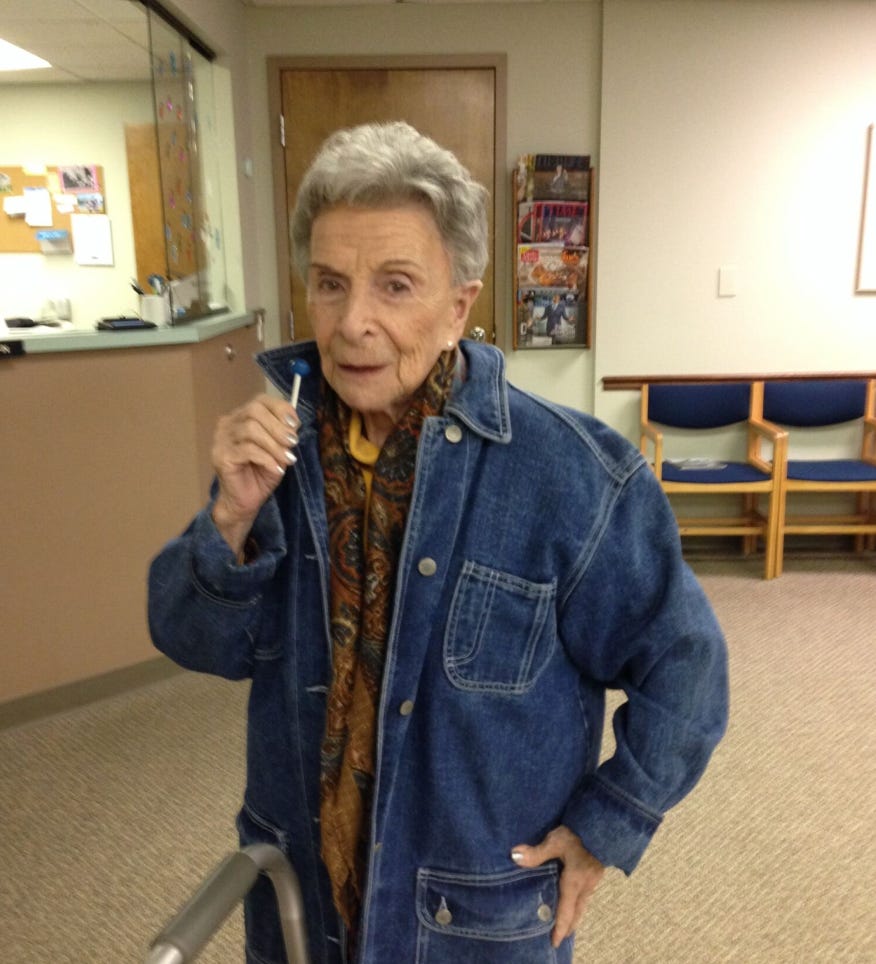
In January, the family gathered to celebrate Hurricane Jackie’s (Mom) 98th birthday. Despite sub-zero temperatures, the event was a success. Currently “cocooned” in her apartment for the winter, HJ plans to come out of hibernation after her next doctor’s appointment or sometime after the clocks spring ahead.
She’s still aging brilliantly, no chronic illness to manage, suffering only the effects of old age—everything is slow and tiring. Her cozy apartment of ten years, in a well-regarded independent living facility, is well-maintained and safe. Sadly, she participates less and less in summer camp for seniors activities.
Yet, as she ages, her continued independence poses a problem for me, who spends two weeks away from her at a time. An event of any kind is increasingly likely to land her in the hospital. If this happens while I’m in Ohio, who will I call to find out where she is? What’s her status? There is no one in her independent-living facility whose job it is to track that. They’re just landlords and activity directors to their 55+ (and in HJ’s case, 95+) tenants.
If she is hospitalized, will she be released into Medicare rehab? Will there be a bed for her? If she can’t come home, I’ll have 20 days of full coverage and 80 more of coinsurance before I need to get her into a permanent skilled care facility. If there’s a waiting list, I’ll have to use home health aides to bridge the gap. Will her independent community even permit that?
What you may not know yet, but I do, is that quality nursing care facilities have a waiting list. And you can’t get on the waiting list (even if you self-pay) UNTIL you need assistance with Activities of Daily Living (ADLs). In other words, you can’t get on a waiting list for nursing care until you have a doctor indicate you already need nursing care.
So, like Beth, I know what I’m in for and there’s not a damned thing I can do to prevent it. There will be a train wreck, and I need to figure out how to mitigate the effect of flying debris.
(You may ask: Where is my brother in all of this? He’s on the other end of a text thread telling me he’s glad I’m handling it and I should just continue to do everything, so he doesn’t have to hurt his brain thinking about it. He is appreciative, of course.)
Our Solution
Our proposed solution is to place a deposit to add HJ to a waiting list in a nearby Continuing Care Retirement Community (CCRC). These are senior living facilities that offer degrees of housing and care that range from independent to nursing and memory care, all within the same campus. They give preferred treatment on the waiting list to those who already reside on the campus. Currently, the waiting list for independent living is 8 to 10 months, and 6 to 8 months for both assisted living and nursing care (once you qualify).
This means that HJ may move to a new independent living facility for her 99th birthday!
But here’s my hope: Should there be an event that hospitalizes my mother and keeps her from coming home between now and then, I will be able to play the “but we’re on the waiting list” card to expedite her access to nursing care. And, once she is part of this CCCR, there will be a person whose role it is to ensure I am kept in the know about her status and her need to transition to a different level of care.
Hurricane Jackie, wise woman that she is, understands the problem from both her perspective and mine. She’s amenable to choosing a solution that makes it easy, assuming there actually is one. We know there is not. But she’s never been one to gather moss. As a matter of fact, she’s already filling carpenter bags with donation clothing and handbags.
Last Sunday, when I made my regular visit, she declared herself “ready for her next adventure.” That’s so like her. She knows there’s at least one more transition before the Big Transition. And she’s going to make it gentle and as painless as possible for us both.
#WeRescueOurselves
Reading: My Mother’s Money: A Guide to Financial Caregiving, Beth Pinsker, CFP®, Crown Currency, 2025 (I highly recommend!)
Studying:
MIT Agelab’s Longevity Preparedness Index (LPI)
Review us on Google! Share your Madrina Molly® experience with other Women of a Certain Age(ncy)®. Spread Sherry around!
Join us on March 12 at 7:00 p.m. Eastern for How to Use Your Roth IRA to Fund a Sabbatical: You think Roth IRAs are just for retirement? Think again. If you’re a Millennial or a Zillennial, you’ll want to take small sabbaticals as you go (because living to work for 50 years without a break is nuts!) Registration is free for Madrina Molly Members in the Community.
Become a Member: For access to fractional CFP® financial and longevity planning or help creating your model, become a Madrina Molly® member. Membership includes access to me for Q&A, member Zooms, my office hours to work on your model, and Madrina Molly’s library of articles and mini courses. 2026 Membership: $379
The “Wish/Want/Will Exercise Workbook” is now available as an eBook. Get your copy for 2026.
“How to Use a Self-Directed Roth IRA to Invest in Startups” is our how-to eBook, in which I explain the mechanics of setting up a self-directed Roth IRA and its benefits as an effective private investment instrument for both accredited and non-accredited investors.
Join The Madrina Molly Walking Club! Keep yourself accountable to your longevity goals by moving every day. No pressure from us, just company while you move. We use the free StepUp app.
Get the Boldin Financial Planning Model. Madrina Molly® Members use the Boldin financial planning software model (with coaching from Sherry) to develop a plan for financial freedom. You can too. (This is an affiliate marketing link.)
Copyright Madrina Molly, LLC 2026
The information contained herein and shared by Madrina Molly® constitutes financial education and not investment or financial advice.
Sherry Finkel Murphy, CFP®, RICP®, ChFC®, is the Founder of Madrina Molly: Financial Wisdom for Women of a Certain Age(ncy)®
this is a great post and so true. way to be proactive!